
Hello!
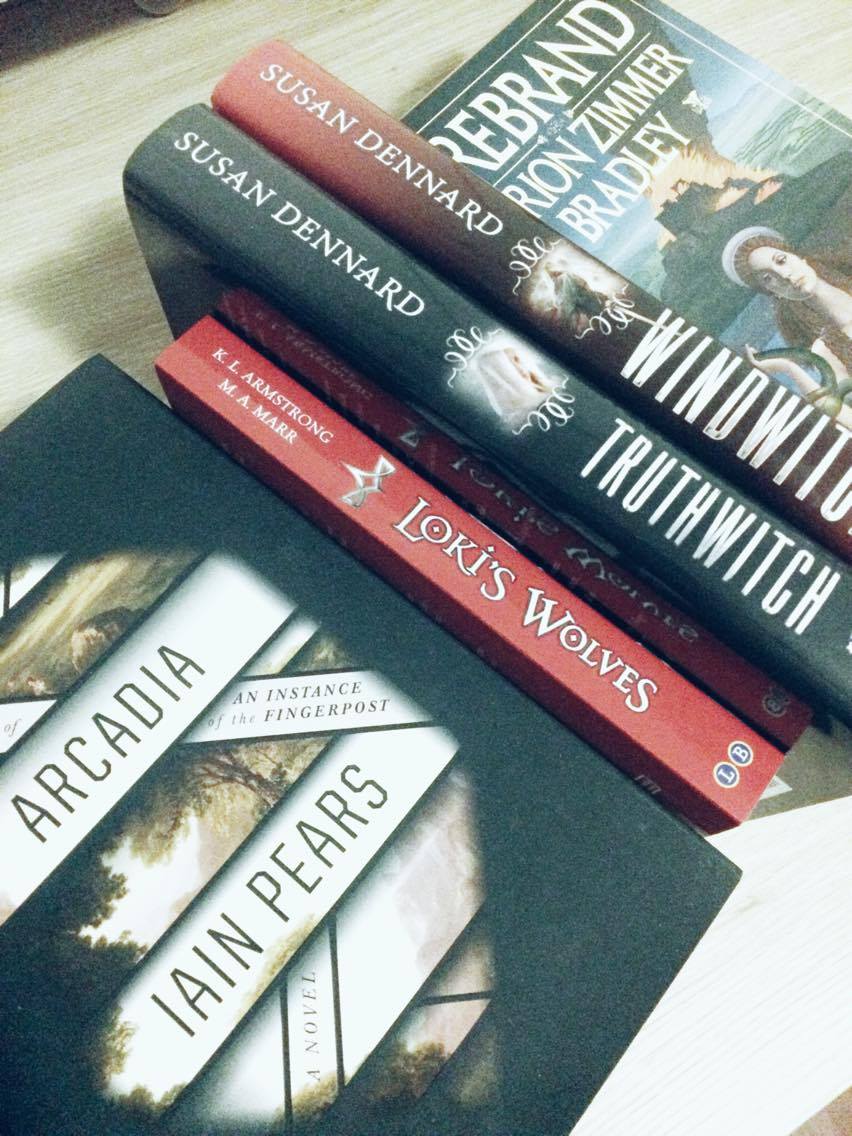
These are the books I got through during #TheReadingQuest, which took place between Sunday 13 August to Sunday 10 September.

Hello!
These are the books I got through during #TheReadingQuest, which took place between Sunday 13 August to Sunday 10 September.
Hello!
I am here with my — belated — August 2017 Wrap Up! These are the book I read in the first half of August. Since #TheReadingChallenge took place in the last half of the month and I will do a wrap up for that.

Hi all,
Yesterday, 22nd August, was 532nd anniversary of the Battle of Bosworth. It was on this day in 1485 that Henry Tudor defeated and killed Richard III, the last Plantagenet king, and took the English crown.
So I thought I would share with you my favourite Richard III books because:
Now onto the books!

If I was pushed to pick a favourite novel of all time, this novel would be it. I adore Penman’s writing. For me it’s the perfect mix of research, compelling characters and engrossing scenes.
The Sunne in Splendour follows Richard Plantagenet from his childhood to his untimely death at Bosworth in 1845. Penman strips back the ugly myth of Richard, the vile hunchback king who murdered his nephews, The Princes in the Tower, and redeems him. Richard III might not horrible tyrant Tudor playwright, Shakespeare, wanted us to believe.
Born in the treacherous courts of 15th century England while the Yorks and Lancastrians fight for the crown, Richard was raised in the shadow of his charismatic brother, Edward IV. We see Richard as a loyal man, one who would defend his brother and friends to the death; as a man who is passionately in love with one women, his queen, Anne Neville. Filled with battles, court politics, 15th century customs and the passion of royalty.

While not my favourite book in the series, mostly because Richard’s character doesn’t stray too far from the Shakespearian depiction, Ravenspur is still a fantastic novel. I thought this one would include this one is particular as it’s the book in the series to have the Battle of Bosworth.
Ravenspur takes place in the final 15 years of The Wars of the Roses. Starting in 1570, we see the Lancastrian’s final play for the throne against Edward IV and his brothers, George Duke of Clarence and Richard Duke of Gloucester. The novel ends with in 1584 with the rise of the Tudor Dynasty.
Iggulden has bring new life into these scheming barons, ruthless queens and ambitious kings. They feel human — living, breathing and real. While reading this series it’s so easy to get swept up in the visceral storytelling that it’s hard to remember all these events actually happened 500 odd years ago. The battle scenes describe the chaos, the fear and pure adrenaline of war, you feel like you’re there.

This was the series, specifically the TV adoption, is what got me hooked on The Wars of the Roses. Promptly after I finished the mini series I tracked down the the books and devoured them.
This series is a made up of companion novels, with most of the narratives over lapping. The Kingmaker’s Daughter narrative play out on the same timeline as The White Queen and The Red Queen. Anne Neville is our protagonist and since she becomes Richard III’s wife this is the novel that focuses on the last Plantagenet king.
We don’t see the battles like we do the other books, as The Kingmaker’s Daughter has a female protagonist. But we get a different kind of fear — the fear of the noble ladies. They sit out the battles, powerless to stop it but also not knowing if they will be striped of their home and titles once the battle ends. The best part of this books is the budding romance between Anne and Richard — it’s swoon worthy.
That’s all for me. Comment down below and let me know if you’ve read any of these. Also if you have any recommendations. I am always on the lookout for more Wars of the Roses novels.
Until next time, happy reading!
Dearna
 Author: Sherry D. Ficklin
Publisher: Crimson Tree Publishing
Published: 19 October 2017
Rating: 5 stars
‘When life makes you a criminal, only love can set you free.’
I will start by saying that I was given an ARC copy in exchange for an honest review. These opinions are my own.
I didn’t read any of the novellas before reading Canary Club, but I don’t think you need to. Canary Club is set in the late 1920s New York and follows the lives of two characters, Benny and Masie in alternating POV chapters.
This book was everything I love about YA and Historical Fiction — life-like setting and swoon worthy romance. The 20s is one of my favourite eras to read about and Ficklin nailed it. I felt like I had been sucked into the era from the first page. She weaves in slang with ease; it never felt off-putting or unnatural for any of the characters. The romance was a slow burn, which I adored. I also enjoyed seeing their relationship unfold from both Benny and Masie’s POVs.
Benny and Masie have definitely become two of my favourite characters. I feel like I know them, that I could head down to a club and have dinner with them. In fact, all of the Canary Club gang feel real. Their speech, action and motivations are believable and a reality for this era.
Masie is a strong character throughout the book when see her fight for independence. She’s constantly rebelling against her father and society. She’s the daughter to one the city’s rising crime bosses. Her father keeps her and her brother, JD, under his control as he builds his empire. But Masie doesn’t want to live life on her father’s terms. She has dreams of Ivy League Colleges, faraway places and security. But can she find the strength to leave her family and do what she wants?
I adore Benny. We meet him as he’s let out of jail and on his way to his family, Mum and younger siblings. He is sweet and will do whatever it takes to keep his family fed and healthy. But he has a habit of always winding up in the wrong place at the wrong time. Quickly his luck lands him in the ranks of Dutch Shultz’s gang. This would’ve been a reality for many people at the time. You see the struggle they would’ve gone through. The only work they can find is running liquor to the speakeasies. It’s dangerous but it also pays better than anything else. Luck, drama, love and setbacks are thrown at Benny but never gives up.
I will be pre-ordering a physical copy. This is one of my favourite books of the year. Please grab a copy! Canary Club it’s stunning. It will suck you in, play with your heart and spit you out the other end. I highly recommend!
Hi there,
I did post my TBR on Instagram before the challenge started but I thought I’d post it here too.
#TheReadingQuest is an awesome four week reading challenge based on video games. The challenge runs from Sunday 13 August to Sunday 10 August. The challenge runs like a bingo board with each title representing a stage (reading prompt) you must complete. The difference is that you’re starting point on the grid depends on the character class you chose.
For more info about the challenge head to Read at Midnight’s blog.
There are four character classes – each represent a character type for a video game:

For this challenge I’ve chosen the The MAGE!
The books I’ve chosen to read are:
All the artwork has been created by the wonderful CW of Read, Think, Ponder.
That’s all for me. Comment down below and let me know if you’re taken part in the challenge and let me know what you’re planning on reading.
Until next time, happy reading!
Dearna

Author: Maxine Beneba Clarke
Publisher: Hachette Australia
Published: 9 August 2016
Rating: 5 stars
‘The margins between events have blended and shifted in the tell of it. There’s that folklore way West Indians have, of weaving a tale; facts just so, gasps and guffaws in all the right places — because, after all, what else is a story for?’
Maxine is hands down one of my favourite authors — I will seriously pick up anything this woman writes. The Hate Race is her third book and her first memoir. It was just as beautiful as her short story collection, Foreign Soil.
Clarke has a magical writing style. Being a poet, her prose has an innate rhythm and melody that grabs your hand and guides you through the narrative. Within the pages of this book, she shares what it’s like growing up in suburban Sydney as the only black family in their town. And just after Australia had dismantled The White Australia Policy—this was a policy that up until the early 70s barred people of non-European heritage from immigrating to Australia.
This book is heartbreaking. It highlights and showcases all the casual and everyday racism, which is embedded in our culture. From people contently question Clarke where she’s from, even though she was born in Australia, and then telling her where she’s from; to PE teacher assuming you’ll be good at track and field because of your skin colour; all mix with that desperate need to fit in at school. The most shocking element wasn’t the playground bullies but the teachers, kids parents and councillors who sat back, excused and at times defended horrible racist behaviour and taunts thrown at Clarke.
It made me angry, it made me cry, it made me laugh at times at all the 90s books, music, shows and toys I also grew up with. It scared me that this wasn’t all that long ago. But ultimately it’s made me hopeful. Having this book is an invaluable insight into an experience I am fortunate enough to never have. It’s through people voicing their experience that our culture can learn and think before making any vaguely offensive comment.
I highly recommend. This book is significant in the fight against racism and a move towards an accepting and inclusive future.
I enjoyed the BookTubeATon so much that I’ve decided to take part in #TheReadingQuest! See my TBR on Instagram @wordsoftheroses!
Let me know if you’re joining it and what character you’ve chosen!

 Hello Adventurers,
Welcome to #TheReadingQuest! I invite you to join me on a reading adventure based entirely on a video-game quest. In this challenge, you’ll be embarking on a journey to conquer your TBR pile through a series of stages. You’ll read new stories, gain experience, and level up a character of your choosing.
The quest will take place between Sunday 13th August to Sunday 10th September, 2017. All adventurers are encouraged to register their interest in the sign up form below, which will be open from now until Sunday 13th August.
I want to give a huge thank you to CW of Read, Think, Ponder. She is the amazing artist behind all of the character illustration you’ll see within this post. You can find her on Instagram, Twitter, and her stunning blog! Please go give her all your love, because I cannot think of…
View original post 1,460 more words
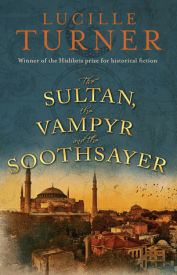
Author: Lucille Turner
Publisher: Hengist Press
Published: 19 November 2016
Rating: 2 stars
This is a review I have been putting off for a while. I’ve had too many thoughts about it and needed time to reflect on them. Ultimately I was disappointed in this book, which is a shame since I thought it would become a favourite of mine.
Just a warning this review may contain mild spoilers – even though it’s based on history I thought I’d mention that.
Turner has a beautiful writing style. It’s visceral and I certainly felt like I was sucked into the 15th century
Ottoman Empire. I can’t fault her writing style.
But…
There was too many point of view characters – from memory, I can recall 8. Because of the huge number of POVs, there were way too many storylines for a standalone. It’s like Turner is using these to try and capture the whole political and religious landscape of the 1400s Eastern Europe. I think there are ways to show this without having so many characters with their own story line. If these changes are important, they will be affecting Vlad. His own country is caught between the Christian church and the Islamic Ottomans.
Most of the book focuses on Vlad’s childhood as the Ottomans, in hopes of keeping his father loyal to the Sultan, take him. Which is awesome to see this backstory. But of a nearly 500-page book, less than 200 pages show Vlad ruling Wallachia or his rivalry with new Sultan Mehmet II. This wouldn’t have be an issue if this was the first in a series but as far as I know, it’s a standalone.
There isn’t much action for a book focused on warring countries. A large portion of the book is spent planning the fall of Constantinople, however, we don’t get the see the fall of the city but instead are given the prelude and aftermath.
Also, there is no impaling, which I could kind of get if this is an origin story. However, when the main character is known as Vlad the Impaler you’re expecting it. Even if this was an origin story, the number of POVs makes Vlad’s character get a little lost – we don’t really get to see the effect all the political planning and scheming has on him.
This isn’t a book I would recommend unless you are aware that it’s not focused on Prince Vlad Dracula of Wallachia and how he become Vlad the Impaler.
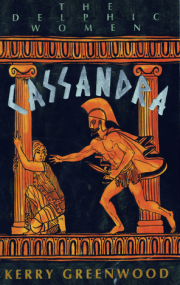
Author: Kerry Greenwood
Publisher: Mandarin (imprint of Reed Books Australia)
Published: 1995
Rating: 5 stars
“It was not a vision. I smelt sweat, grease, salt, men and burning. Always the burning reek of wood and flesh which soured my nostrils and seared my throat.”
Cassandra is based off the prophecy cursed character from the Greek Myth of The Trojan War. Along with Cassandra, we have a second protagonist Greek healer Diomenes. Both characters are pawns for two of the Gods – Apollo and Aphrodite – as they see whose power is stronger.
This is an incredible retelling. I’m in awe of the way Greenwood is able to balance the fantastic elements of the Gods with the historical setting and culture of the ancient world. All the characters feel very grounded in a real historical setting. And the Gods feel like accurate representation of what the Ancient Greeks believed them to be.
The story doesn’t stray too far from the major plot points in the myth. And even though these events are prescribed they don’t feel out of place in the context of the story and they still pack an emotional punch. While reading it at work I was on the verge of crying three times — if I was home I would have been a sobbing mess!
I enjoyed learning about the differences in the Greek and Trojan cultures — how they celebrated the Gods, which Gods they favoured, women’s roles and healing practices.
I highly, highly recommend for any one interested in myth retellings or who is a fan of books set in antiquity.

Author: Anjan Sundaram
Publisher: Bloomsbury Circus
Published: 2016
Rating: 4 stars
“But the written word belongs to no one. It has no source, no root that can be annihilated. It passes from hand to hand. It is destroyed; new words are written.”
What is the price of knowledge? Or free speech? In our Western world these are fundamental rights we take for granted. Bad News shows us just what that price is.
Sundaram gives us insight into a country still feeling the political and social unrest of the 1994 Rwandan genocide that shocked the world.
Sundaram is a journalist who is teaching a class of Rwandan reporters. This book is not one for the faint of heart. While not overtly gory, Sundaram is blunt is his recount of his time in Rwanda. He refuses to censor his own or his students experiences.
Bad News will tear you apart in all the right ways but leave you hopefully that change can happen.

 wordsoftheroses.com