The Hate Race

Screen Shot 2017-08-13 at 4.15.23 pm

Author: Maxine Beneba Clarke

Publisher: Hachette Australia

Published: 9 August 2016

Rating: 5 stars


‘The margins between events have blended and shifted in the tell of it. There’s that folklore way West Indians have, of weaving a tale; facts just so, gasps and guffaws in all the right places — because, after all, what else is a story for?’

Maxine is hands down one of my favourite authors — I will seriously pick up anything this woman writes. The Hate Race is her third book and her first memoir. It was just as beautiful as her short story collection, Foreign Soil.

Clarke has a magical writing style. Being a poet, her prose has an innate rhythm and melody that grabs your hand and guides you through the narrative. Within the pages of this book, she shares what it’s like growing up in suburban Sydney as the only black family in their town. And just after Australia had dismantled The White Australia Policy—this was a policy that up until the early 70s barred people of non-European heritage from immigrating to Australia.

This book is heartbreaking. It highlights and showcases all the casual and everyday racism, which is embedded in our culture. From people contently question Clarke where she’s from, even though she was born in Australia, and then telling her where she’s from; to PE teacher assuming you’ll be good at track and field because of your skin colour; all mix with that desperate need to fit in at school. The most shocking element wasn’t the playground bullies but the teachers, kids parents and councillors who sat back, excused and at times defended horrible racist behaviour and taunts thrown at Clarke.

It made me angry, it made me cry, it made me laugh at times at all the 90s books, music, shows and toys I also grew up with. It scared me that this wasn’t all that long ago. But ultimately it’s made me hopeful. Having this book is an invaluable insight into an experience I am fortunate enough to never have. It’s through people voicing their experience that our culture can learn and think before making any vaguely offensive comment.

I highly recommend. This book is significant in the fight against racism and a move towards an accepting and inclusive future.

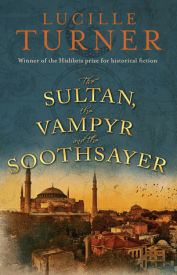
The Sultan, the Vampyr and the Soothsayer

Screen Shot 2017-08-13 at 3.54.21 pm

Author: Lucille Turner

Publisher: Hengist Press

Published: 19 November 2016

Rating: 2 stars


This is a review I have been putting off for a while. I’ve had too many thoughts about it and needed time to reflect on them. Ultimately I was disappointed in this book, which is a shame since I thought it would become a favourite of mine.

Just a warning this review may contain mild spoilers – even though it’s based on history I thought I’d mention that.

Turner has a beautiful writing style. It’s visceral and I certainly felt like I was sucked into the 15th century
Ottoman Empire. I can’t fault her writing style.

But…

There was too many point of view characters – from memory, I can recall 8. Because of the huge number of POVs, there were way too many storylines for a standalone. It’s like Turner is using these to try and capture the whole political and religious landscape of the 1400s Eastern Europe. I think there are ways to show this without having so many characters with their own story line. If these changes are important, they will be affecting Vlad. His own country is caught between the Christian church and the Islamic Ottomans.

Most of the book focuses on Vlad’s childhood as the Ottomans, in hopes of keeping his father loyal to the Sultan, take him. Which is awesome to see this backstory. But of a nearly 500-page book, less than 200 pages show Vlad ruling Wallachia or his rivalry with new Sultan Mehmet II. This wouldn’t have be an issue if this was the first in a series but as far as I know, it’s a standalone.

There isn’t much action for a book focused on warring countries. A large portion of the book is spent planning the fall of Constantinople, however, we don’t get the see the fall of the city but instead are given the prelude and aftermath.

Also, there is no impaling, which I could kind of get if this is an origin story. However, when the main character is known as Vlad the Impaler you’re expecting it. Even if this was an origin story, the number of POVs makes Vlad’s character get a little lost – we don’t really get to see the effect all the political planning and scheming has on him.

This isn’t a book I would recommend unless you are aware that it’s not focused on Prince Vlad Dracula of Wallachia and how he become Vlad the Impaler.


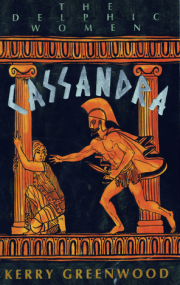
Cassandra

Cassandra

Author: Kerry Greenwood

Publisher: Mandarin (imprint of Reed Books Australia)

Published: 1995

Rating: 5 stars


“It was not a vision. I smelt sweat, grease, salt, men and burning. Always the burning reek of wood and flesh which soured my nostrils and seared my throat.”

Cassandra is based off the prophecy cursed character from the Greek Myth of The Trojan War. Along with Cassandra, we have a second protagonist Greek healer Diomenes. Both characters are pawns for two of the Gods – Apollo and Aphrodite – as they see whose power is stronger.

This is an incredible retelling. I’m in awe of the way Greenwood is able to balance the fantastic elements of the Gods with the historical setting and culture of the ancient world. All the characters feel very grounded in a real historical setting. And the Gods feel like accurate representation of what the Ancient Greeks believed them to be.

The story doesn’t stray too far from the major plot points in the myth. And even though these events are prescribed they don’t feel out of place in the context of the story and they still pack an emotional punch. While reading it at work I was on the verge of crying three times — if I was home I would have been a sobbing mess!

I enjoyed learning about the differences in the Greek and Trojan cultures — how they celebrated the Gods, which Gods they favoured, women’s roles and healing practices.

I highly, highly recommend for any one interested in myth retellings or who is a fan of books set in antiquity.

Bad News: Last Journalist in a Dictatorship

Bad News

Author: Anjan Sundaram

Publisher: Bloomsbury Circus

Published: 2016

Rating: 4 stars


“But the written word belongs to no one. It has no source, no root that can be annihilated. It passes from hand to hand. It is destroyed; new words are written.”

What is the price of knowledge? Or free speech? In our Western world these are fundamental rights we take for granted. Bad News shows us just what that price is.

Sundaram gives us insight into a country still feeling the political and social unrest of the 1994 Rwandan genocide that shocked the world.

Sundaram is a journalist who is teaching a class of Rwandan reporters. This book is not one for the faint of heart. While not overtly gory, Sundaram is blunt is his recount of his time in Rwanda. He refuses to censor his own or his students experiences.

Bad News will tear you apart in all the right ways but leave you hopefully that change can happen.

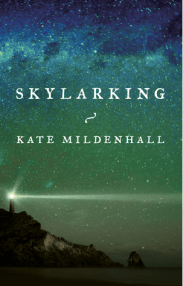
Skylarking

Screen Shot 2017-08-13 at 3.54.33 pm


Author: Kate Mildenhall

Publisher: Black Inc.

Published: August 2016

Rating: 4 stars


‘I remember the way Harriet turned, breathless, laughing, a strand of her golden hair caught on her bottom lip. 
After that, I try not to remember’

Skylarking takes place on an isolated Australian cape in the 1880s. It follows Kate and Harriet, the daughters of lighthouse keepers. The pair grows up together and consequently shares everything until fishermen, McPhail, moved into their tiny community.

Mildenhall has created a beautiful and immersive novel. It’s hard to believe it’s her debut! After a while you can hear the waves crash against the cost and feel the salt brine on your skin. Skylarking is based on true events. Mildenhall has done a beautiful job of bringing the story to life and showing all the complexities of a tight knit friendship.

I highly recommend and am looking forward to Mildenhall’s next novel!

REVIEW: Rules of Civility

… life is less like a journey than it is a game of honeymoon bridge. In our twenties, when there is still so much time ahead of us, time that seems ample for a hundred indecisions, for a hundred visions and revisions — we draw a card, and we must decide right then and there whether to keep that card and discard the next, or discard the first card and keep the second. And before we know it, the deck has been played out and the decisions we have just made will shape our lives for decades to come.

Maybe that sounds bleaker than I intended.


Hi all! I’m here with a new review. I adored this book and just couldn’t stop thinking about it. So I’m going to share my view with you in hopes you will all want to read it.


I will stress that this review was not commissioned or request by anyone and I’m not getting paid. All thoughts on this book are my own opinion.


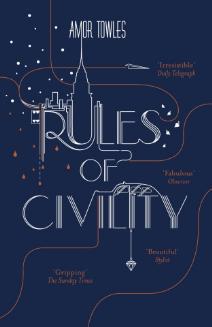
Rules of Civility

11931826

Author: Amor Towles

Genre: Historical fiction

First published: 2011

Publisher: Sceptre (imprint of Hodder & Stoughton)

Page number: 324


On the last night of 1937, twenty-five-year-old Katey Kontent is in a second-rate Greenwich Village jazz bar with her boardinghouse roommate stretching three dollars as far as it will go when Tinker Grey, a handsome banker with royal blue eyes and a tempered smile, happens to sit at the neighbouring table. This chance encounter and its startling consequences propel Katey on a yearlong journey from a Wall Street secretarial pool toward the upper echelons of New York society and the executive suites of Condé Nast–rarefied environs where she will have little to rely upon other than a bracing wit and her own brand of cool nerve.

Wooed in turn by a shy, principled multi-millionaire and an irrepressible Upper East Side ne’er-do-well, befriended by a single-minded widow who is a ahead of her time, and challenged by an imperious mentor, Katey experiences firsthand the poise secured by wealth and station and the failed aspirations that reside just below the surface. Even as she waits for circumstances to bring Tinker back into her life, she begins to realise how our most promising choices inevitably lay the groundwork for our regrets.


My rating: 5


This was a book I picked up on a whim at during a secondhand book sale because it’s set in New York during the 1930s. So where do I start.

This is a beautifully written book. Towles proses are lyrical and he manages to capture the essence of the 30s perfectly. Everything from setting, character’s behavior, food, clothing, technology is so vivid that you feel like you are there.

Going into the novel, I was worried has there are no quotation marks. So dialogue is signaled with a dash (ie. — Maybe the moon, I conceded). But I never had a issue telling what was spoken and what wasn’t. This is mostly because Towles rarely includes dialogue attributions and if there is a group of people talking it’s written like script. For example:

If you could be anyone for a day, who would you be?

Me: Mata Hari

Tinker: Natty Bumppo.

Eve: Darryl Zanuck.


I adored the structure of this novel. It opens with Katey and her husband at an art show during the 60s. The exhibit they go to see is a photographer’s work from the 20s and 30s – he took photos of people on trains. During the show, Katey notices two photos of her old friend, Tinker Grey. This moment sparks Katey in remembering the year she met him, 1938. For here the book spans over a year and splits into seasons – Winter, Spring, Summer and Fall (or Autumn). Its amazing to see just how much a persons life can change over the course of a single year – from the friends you gain and lose, your career, appearance and the place you love to go.

This will come as no surprise, but I highly recommend that everyone read this book. I think it is beautiful is every way shape and form. If you are interested in this novel please, please read it.


That’s all for me for today, comment down below and let me know if you’ve read Rules of Civility and what you though.

Until next time, happy reading!

Dearna

REVIEW: The Virgin Suicides

Hi all! Sorry for my lack of posting last week but I’m back with my much hinted at book review. This is my first official review so lets get started.

First off I will just you an overview of The Virgin Suicides and my general thoughts. There will be a spoilery discussion section but I will give you fair warning in case you have yet to read it – because we all know there is nothing worse than someone spoiling a book for you.


The Virgin Suicides
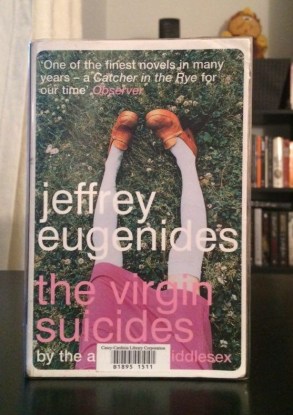
VIRGIN SUICIDES

Author: Jeffery Eugenides

Genre: YA Contempory

First Published: 2005

Page Numbers: 249


This book follows the neighbourhood boys as they look back on their adolescence and the traumatic event that shakes their town. The Lisborn sisters seem relatively normal for the only date their mother let them out on. Twenty years on, their enigmatic personalities are embalmed in the memories of the boys who worshipped them: the brassiere draped over a crucifix belonging to the promiscuous Lux; the sisters’ breathtaking appearance on the night of the dance; and the sultry, sleepy street across which they watched a family disintegrate and fragile lives disappear.

This book as a trigger warning for suicide and I wouldn’t recommend if you’re not comfortable hearing about how these sister take their lives.


My Rating: 2 1:2


I was pulled into this book immediately by the beautiful first line. My biggest issue this that I just don’t feel like this book and what I’d heard about this book lived up to the first line or my expectations. Which is a real shame because I was looking forward to reading this but ultimately Eugenidies, I don’t feel, answer any of the question we have about the Lisborn girls and why they did what they did. I understand that having the story we’re not going to get an in-depth explanation but I felt like there wasn’t’ an explanation at all. And the boys didn’t seem to care about why they all decided to commit suicide but rather focus on remembering how in love they were with these mysterious girls.

Personally I wouldn’t recommend this, but if this sounds like something you’re interested in, have seen the movie adaption or want to form your own opinion of this novel – as I think mine is in the minority – I suggest reading it as it’s quite short and fast paced read.


SPOILERY DISCUSSION

I knew that is novel was told through the perspective of the neighbour boys — which, at first, I really enjoyed. I loved the idea of piecing together what happened by watching this unfold from the outside. However I do feel like way too many characters were given quite extensive backstory only to the once and used just to tell us one aspect of one of the Lisborn sister’s life. For example the youngest sister, Cecilia’s friend is given a huge background story just to tell us that Cecilia was upset that the guy she had a crush on was in love with some other girl. Also another guy also gets a background story only to tell us that Lux Lisborn had sex with him and the weird, alternate contraception methods she uses.

I will say that having the story told through a group persective was interesting. As a reader it really draws you in to feel like one of these boys. So because I felt that way I would’ve been better to remove these minor character’s backstories and let me as the reader fill in the blanks.

My biggest problem is this idea that the girls had a suicide pact, which I suppose at the end they did, but at the start when the youngest sister first ends her life the other seem to resent this idea and the extra care they are given.

Also I felt like we still have no idea why in the end these girls decided to end their lives and in such violent ways. Cecilia first suicide attempt is to cut herself; however her mother comes home into to save her. The way she kill herself was horrific – she jumped off the roof and impaled herself on the fence. But I saw nothing to justify such a violent death. Yes her mother was strict with them but never hints at abuse and its reference several times just how much the father adores the girls. For me if someone has decided to end their life if such a violent way is because they have been through something severly traumatic.

Similarly I feel that the parent’s reaction to Cecilia’s death was wildly unrealistic. I just don’t see how they could neglect their other daughters. Yes I can imagine there would be a long grieving period because as people we can’t just get over the loss of a love one so quickly but I would’ve thought your other children would be a pretty good motivator to get back to everyday life.

Finally the boys. I know that they are looking back on this time but I feel like for a bunch of guys who claim to be in love with these girls they spend too much time remembering what they looked like and what they wore rather than focusing on the mystery of what the hell happened to make all five Lisborn sisters end their lives. Because these group of boys where obsessed to the point where they where watching these girls every move, the collected some of their vinyl and the crucifix Lux used to drape her bras on. Also there were there in the Lisborn house during the last suicides. One of the girls, Lux from memory, calls them and tells them to come over and save them, to run away with them. However while they were in the house, Therese is in the process of overdosing on sleeping pills and Bonnie’s hung herself in the basement. Lux lets them inside and tells them to wait there while she gets the car, where she dies due to carbon monoxide poisoning. So they were there, both watching from their house across the road and inside the house and the last 3 Lisborn sisters commit suicide and they still don’t know what happened!!

As you can tell my biggest frustration with the book is that we don’t know why this happened, even from reading into what they observed of the family we never know what happens. I’m not saying I wanted Eugenides to spell out everything that happened but I think a few more solid clues and hint would’ve been helpful.

I don’t know maybe I read it wrong but anyway these were my issues with the book.


That’s all for me for today, comment down below and let me know if you’ve read The Virgin Suicides and what you though.

Until next time, happy reading!

Dearna